Tuesday, October 29, 2013

There's always someone with a bigger boat.

A friend raised an interesting question on Facebook today, and it touches on a topic I've been mulling over, balance and extremism in work, sport, hobbies, and life.


This quickly garnered a lot of thoughtful, insightful answers. Many touched on self-understanding, suggesting that if you understand why you are doing something, this can guide you in how committed (or balanced, or extreme) you are in doing it. Good stuff to think about, especially as the trail racing season begins to wind down and we head into the natural time of year for laying plans and preparing.

Here is my answer to the question:

We lived on Lake Minnetonka until I was 11 years old, and my parents owned a lovely old wooden Chris-Craft cabin cruiser. It was a lot of work for Dad to maintain (he says maintenance on a wooden boat is proportional to the length of the boat, squared), but he loved to take us out for endless summer evening cruises on the lake. I loved that smell of lake water and diesel fuel, and the cold-then-warm feeling of water splashing on your bare legs.
This isn't it, but similar. From www.yachtforums.com
Anyhow, Dad once commented that on a lake like Minnetonka, you can go along, feeling pretty proud of your boat. "But," he said, "There's always someone out there with a bigger boat." No matter how big or fancy your boat is, there's always someone who's gone bigger, sunk more money or more time into their boat.

I love this story because in may parts of life, there's always someone with a bigger boat. It's certainly true in running. You can always find someone who gets up earlier, runs more miles, trains in gnarlier conditions, does crazier stuff during a race. And especially in the era of ubiquitous social media, it's easy to find extremes on blogs, DailyRun, Strava, Facebook and Twitter. As an aside, it's interesting how many ultramarathoners bring to the sport a personal history of substance abuse and addiction. It seems that for many, running is therapy, medicine... maybe a substitute for a more destructive habit.

You can always go further down the rabbit hole, and chances are, someone already has gone there before you. At different seasons of your life, different degrees of balance (and imabalance) are right. You're healthy, single, free time available and want to train insane? Very different from ten years later, when you might be married, have kids, a start-up business and a nagging injury. Think about your season of life and your commitments. Think about how you WANT to balance things. Acknowledge that someone will have a bigger boat. Then go out and enjoy a long sunrise cruise in your own boat.


Tuesday, October 22, 2013

Race report: Wild Duluth 50K 2013

I had a great time running the Wild Duluth 50K this last Saturday. This is a friendly, old-school trail race with options for 100K (the final event in the 5-race Gnarly Bandit Ultra Series -- incredibly, 8 people completed it this year), 50K, and half marathon distances.

I had decided not to run the TC Marathon two weeks ago, reasoning that with spotty training, I could probably do it or Wild Duluth, but probably not both. And I wanted to do Wild Duluth. So on marathon weekend, I opted instead for a solid 6 hour, 24 or 25 mile run at Afton, then 5.5 miles the next morning, just as the TC 10 Mile was starting. Looking at my training schedule over the summer, I think this was the right choice: I had gotten in a number of good long trail runs, but nothing on roads longer than 11 miles since July. Hard to imagine that 26.2 road miles would be a Good Idea.

Wild Duluth 50K is a point-to-point race, starting this year at the UMD outpost (previously started at Jay Cooke State Park, but last year's massive floods washed away road access and trails) and ending in the heart of Duluth, at Bayfront Park. The 100K is an out-and-back, starting and finishing at Bayfront Park.
Add caption
There's a total of 3400 ft of climbing and 3800 of descending on the 50K course -- much less than at the Spring Superior or Afton 50K courses, but finish times are generally 45-60 min longer. The reason seems to be the character of the trail -- lots of big blocky rocks and a fair bit of steep rocky climbing and descending makes the trail less "runnable", especially from miles 11-22.

My Superior finish time was 8:00:18. My "A" goal for this race was sub-8 hours, my "B" goal was sub-9, my "C" goal was to run happy and feel good.

I was up at 3:45 to drive to Duluth, and drove through spotty rain showers and a little bit of sleet coming into town. I felt bad for the 100Kers, who had started by now and were experiencing semi-frozen rain in the dark while climbing rocky trails. After a brief panicky driving-around-the-harbor interval, I found the buses just in time and scrambled aboard, forgetting my gaiters but managing to grab my other essentials -- hat, gloves, socks, hydration pack, camera.

By the time we reached the start/100K turnaround, the sun was reluctantly coming up and the rain had mostly stopped. It was about 35 degrees, but not much wind. I knew I'd warm up once I got going.
Keeping warm before the start
112 runners started the 50K, and 110 finished. Not bad!
 There was a short race briefing from the director (follow the orange flags, follow the Superior Hiking Trail blue blazes, if they disagree, stay on the SHT), a countdown, and a few minutes after 8 am, we were off!

The very first section followed a rocky trail along the Saint Louis River gorge. Beautiful! The roar of the water was loud and the woods smelled damp and fertile. The trail was narrow (RD had warned us about the bottleneck), but it was okay to hike it and get a feel for the traction on damp rock.

A crowded start, but hey, I'm not going for the course record.
 After just a few tenths of a mile, the trail opened out onto the paved, level Munger Trail, which we followed to Aid Station 1 at 3.5 miles. It was odd to be running on a straight, paved bike trail at the beginning of a trail ultra, but a good chance to meet some of the runners and talk a little before the trail got more demanding.
A beautiful day for a run!
 By the time we reached AS1, I had shed my long-sleeve T-shirt, hat, armwarmers, and gloves, and was down to just my T-shirt and shorts. I would be comfortable in this for the rest of the race, putting my gloves back on a few times when the wind picked up.

The course left Munger trail and headed onto the Superior Hiking Trail.
The trail started wide and well graded, and narrowed to singletrack in a few miles.
 The next 7.5 miles, to AS2, were very runnable and a real pleasure. The sky remained overcast, the trees were just past peak but still full of color, there were giant puffball mushrooms growing in a meadow (GIANT! at least 18" across). I drank water, ate Picky Bars and Larabars, and enjoyed the day.

Near AS2, the first 100K racers came by, moving incredibly steadily and fast. I think there was a new course record set? It was great to see them looking so strong.

AS2 was staffed by the Upper Midwest Trail Runners -- my people -- and they were having a great time. In no time, my water was refilled, my trash disposed of, I had been offered Swiss Cake Rolls ("Don't worry, they're paleo!") and instead taken a hard-boiled egg and some salted potatoes, and I was on my way.

The next leg summited Ely's Peak. Shortly after the aid station, there was a steep, rocky climb, blending at times into a class III/IV scramble. The rain had stopped early in the morning, but the rock was still pretty slippery. The sun began to break through and I was definitely glad I'd gone with shorts instead of tights.
What a view!
 From this point until AS5 at mile 22, the trail was pretty technical -- steep climbs and descents, big bouldery rocks in the trail, beautiful and challenging stuff. I just wound along the trail, following blue blazes, eating Shot Bloks and more Larabars, occasionally talking with other runners but often with the trail to myself. It was a great day to be out.

At mile 17.7, we reached Spirit Mountain, near the start of the half marathon. This was another super friendly and helpful aid station. The volunteers at Wild Duluth were really excellent.
Happy at Spirit Mountain
 Long sections of the trail ran alongside streams and rivers. There were lots of bridged river crossings and lots of boardwalks, which were dangerously slippery. I only fell once, on a slick muddy slope. If you were careful, you might be able to do the whole course without getting your feet wet (though mud was inevitable). I got a little wet and muddy, though. For this race, I was glad I was wearing Peregrines, which have pretty burly traction and are nimble, rather than Hokas.
Lots of rushing water, but all the crossings had good bridges
The segment from Spirit Mountain to AS5, mile 22, was a verrrry long 4.5 miles. I think it took me somewhere between 1:15 and 1:30. Lots of steep climbs and descents, not much runnable trail, I lost the trail once, briefly, but quickly found it again. But at AS5, Lisa, a local runner, told me, "We're through the 'W'. That's the hardest part. It's all runnable from here!"

Sure enough, heading out of the aid station, the trail climbed, but not so steeply, and we were on a ridge overlooking Duluth. The views gradually unfolded. First the lake in the distance:

See the sunbreak? It was turning into an amazing day
... then the edges of the city:

... and the cityscape unfolded far below us. Still about 8 miles to go from here.
I just kept chugging along, eating Gu and more Shot Bloks, salted potatoes when the aid stations had them, and Coke at the last two. My legs were getting tired, especially my going-downhill muscles, but everything still felt just fine. I actually couldn't believe how good I felt.

The last 3 miles of the trail climbs up to the watch tower in Enger Park in Duluth, then descends steeply to finish along sidewalks, across the interstate and the train tracks, at the park. In Enger Park the route goes right past a huge Japanese peace bell hanging in a pavilion. A few kids were ringing it as I passed and it deep resonance went on and on, for a long time. Then I plummeted down the hill into Duluth, and before I knew it I was rounding the corner coming into the finish line.
What a great day!
I was impressed by the fantastic finisher's prize -- a ceramic soup bowl and spoon -- and got a nice long sleeve tech shirt. There was hot chicken wild rice soup, and friendly volunteers serving it. A nice, low-key finish to a very nice race.

My finish time was 8:05:51 -- 82 of 110 finishers. I'm thrilled with this time, and I feel like it's an improvement on my performance at Superior. Which, considering my wonky summer of iron-deficient training, is pretty awesome.

Just as important, I felt really good the whole run, and three days later, I seem to be recovering well from the race. I'm really glad I did Wild Duluth and I think it'll stay on the schedule in the future. It's a rugged, challenging, and beautiful course, and it was well marked and well supported. It was fun to meet many local Duluth area runners, and inspiring to see the 100K runners on the course (including the Gnarly Bandits -- congratulations, you guys!). I came away from the race energized, inspired, and more in love with trail running than ever.

Friday, September 20, 2013

Birthday cake (the gluten-free, dairy-free edition)

It's birthday season at our house. Both of the boys were born in September, my husband in October, and my birthday is at the end of December. Since we started avoiding gluten and casein (dairy) almost two years ago, we've figured out lots of ways to eat well without these ingredients. As luck would have it, I already had an almost-flourless chocolate pudding cake in the armamentarium, and it was easy to convert it to a fully gluten free, casein free version.
"Can I lick the knife afterward?"
The kids love this dessert because (a) it's delicious, warm and gooey, and (b) you get to mix it up in the food processor, which makes a terrific racket grinding up the chocolate. I like it because (a) it comes together incredibly fast (you actually steam it in the microwave rather than baking it, so cook time is 4-5 min, rests 10 min, then eat), and (b) it makes a small-ish dessert (about 6-8 servings -- it's rich) to minimize drama over leftover cake.

I  haven't tried it but suspect you could pull off a fully paleo-fied version, substituting in almond flour and sweetener of your choice (date sugar or maple sugar might work well) for the flour and sugar.


We serve this warm with coconut milk ice cream; it would also be incredible with sorbet or just fresh fruit. If you serve it warm, you can't frost or decorate it, but if you cooled it, you could decorate it as a volcano (I'm imagining raspberry puree or strawberry jam as the lava), a turtle (maybe a banana head and legs with raisin eyes?), or anything else you could build around a hemispherical cake.

The recipe is adapted (by me) from Barbara Kafka's cookbook Microwave Gourmet. It was published in the New York Times on April 2, 2008.

Steamed Chocolate Pudding Cake, the Gluten-Free, Casein-Free Version
Time: 15 min
Servings: 6-8


2 Tbsp room temperature ghee or coconut oil (original recipe: butter)
8 Tbsp chilled ghee or coconut cream (original recipe: cold butter, in pieces)
8 oz semisweet or dark chocolate
1/2 c light brown sugar, packed
1 tsp vanilla extract
1/2 c full-fat coconut milk (original recipe: heavy cream)
1/3 c gluten-free baking flour, corn flour, or almond meal (original recipe: flour)
1/2 tsp baking powder
3 eggs


1. Use room temperature fat to grease a 4-cup microwave-safe bowl.
2. Put the chocolate in a food processor and grind it (note: LOUD!), 

then add the cold ghee/coconut oil and sugar.
Process until combined. Add the remaining ingredients and process until smooth.

3. Pour into the greased bowl

and cover tightly with plastic wrap. Microwave on high for 4 to 5 min, or until just set. Remove, pierce the plastic with the tip of a sharp knife, and cover with a heavy plate.
Let it rest for 10 min. (It keeps cooking during this time, so don't skip this step!)
4. Unmold onto a serving plate and serve warm or cold.

Cake and ice cream! Birthday ultra classic.

Tuesday, September 17, 2013

Race report: Babes in Bikeland 7 alleycat bike race

I had a great time riding in the seventh annual Babes in Bikeland alleycat race this Saturday. Last year's Babes was my first experience doing a bike race of any sort, and it was SO FUN. Plus, at $5 for the event (plus $10 for a good T-shirt), it's the best deal on my race calendar, by far. Babes has fantastic volunteers and sponsors, and I want to give them a public shout-out here, because it's a great race and they make it fun. I was looking forward to racing through the Minneapolis streets again.

Babes is an alleycat race specifically for women (and female-identifying people). An alleycat is a race with a set of checkpoints but no set route. At the start, you receive the manifest -- a list of checkpoints throughout the city -- and determine which order you want to hit them, and by which route. Volunteers at the checkpoints may require you to complete a task of some sort before signing your manifest. Once you've been to all the checkpoints (and had your manifest signed -- don't lose the manifest!), on to the finish line, and usually socializing and beer.

Alleycats were started by bike couriers, and reward not only fast riding, but clever route-planning and knowledge of the streets and urban geography. I do okay on these, having biked Minneapolis regularly for two and a half years, but the winners in these events are so much faster and more savvy about route-finding than I am that it's pretty amazing. To give some perspective, I finished this year's event in the top third of finishers, in about 1 hour, 55 minutes. I think my routefinding was pretty efficient and I rode reasonably hard (until the last checkpoint, see below). By contrast, the winning woman did it in an hour and 16 minutes. Smokin'!

The weather was beautiful, crisp, and sunny early in the day, but as the 5 pm start approached, it became increasingly ominous. The Doppler showed a large green-and-yellow rain blob moving eastward over Minnesota. I packed my raincoat and, at the last minute, some armwarmers and a wool buff to wear under my helmet if it got cold. I made sure my lights had fresh batteries, oiled my chain, put air in my tires, and carried my flat-tire kit and pump, just in case.

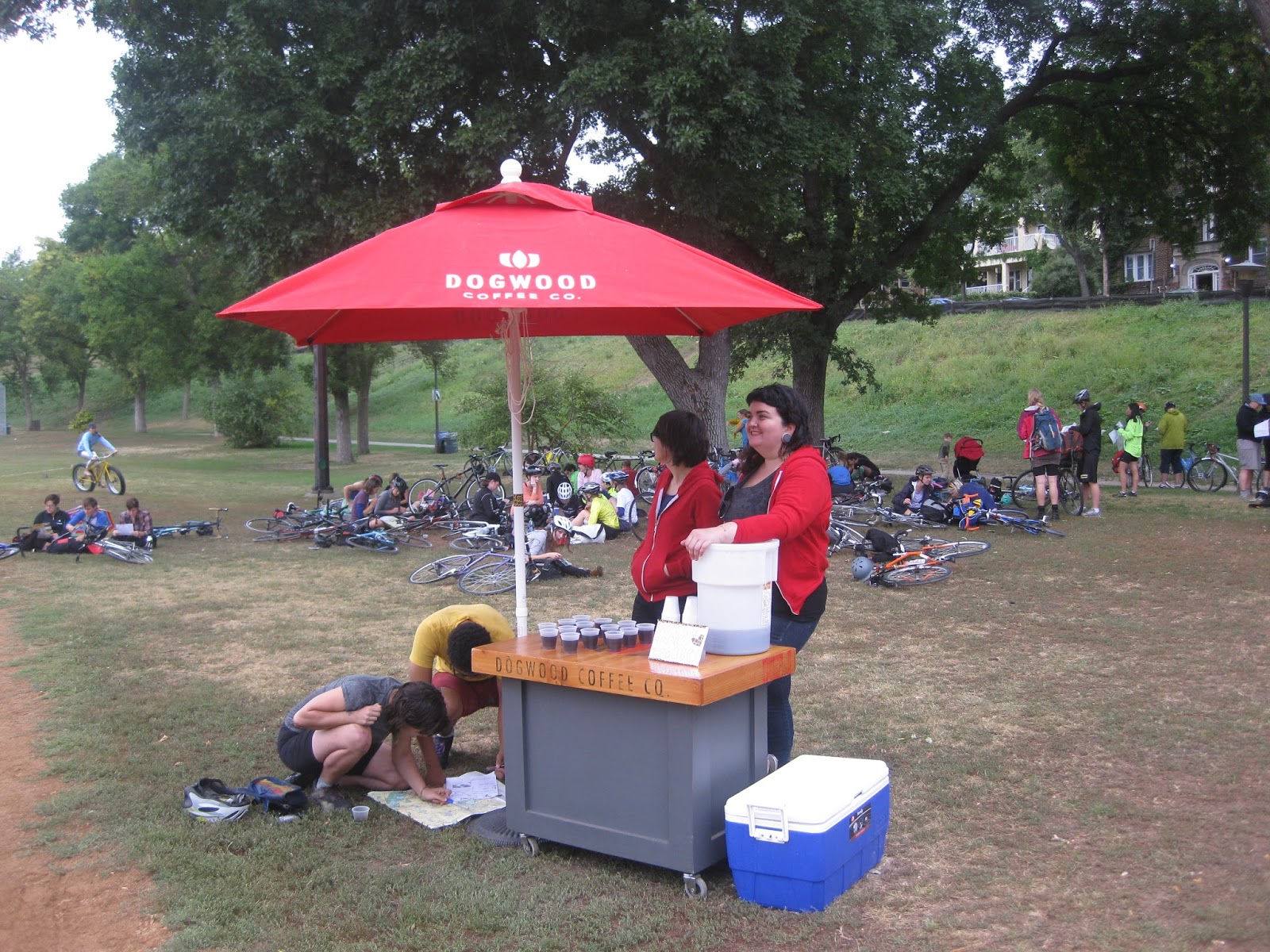
I registered an hour before the start, got my manifest and some fabulous cold-brew coffee (thanks, Dogwood!),
These very cool ladies served GALLONS of iced coffee. Hooray!
and got to work with my map and a pen, just as light rain started falling. This year there were nine checkpoints, biased toward southwest Minneapolis, with the finish line/afterparty at a sculpture studio in Northeast Minneapolis.
Lots of people this year used iPhones and other electronic mapping devices, but I'm old school. Plus, a map shows you everything, fast. If you know the city streets at all, it's a better choice, I think.
This event draws lots of groups, and everyone was figuring out their routes and plans in the light rain. There were bikes and riders all over the park -- a total of 334 started, and 238 finished before the 3 hour cutoff.
Working out routes.
There were some well-dressed riders! A few had fantastic costumes, too.


Under the trees it was a little drier.
As the clock ticked toward 5 pm, we lined up and got ready to start. 
credit: babesinbikeland.com
I had my map, I had my plan, I had my routes written somewhere handy,
Note to self: Bring a better pen next year
and I was ready to go. After a briefing, including a reminder to ride safely in the rain, we counted down, and we're off!
Start line selfie. It started raining harder at this point, though, and I put on my raincoat. Less INKnBURN exposure, but much much drier.
My route took me up through my neighborhood, then eastward and down along the river to a Mississippi River overlook. Then a long stretch west to Hennepin Avenue, and a northward zigzag, hitting checkpoints all the way up through Uptown and into Loring Park. A sunset ride through downtown on Hennepin and across the Hennepin suspension bridge, a detour to Nicollet Island, and a finish in Northeast. It was a good tour of the city (though not quite as diverse and far-flung as last year's route). I rode about 18.5 miles.
This year's route. I think this was pretty efficient, though maybe not perfect.
Every checkpoint had a task or activity. The first, at Spokes, was to make a set of helmet antennae using pipe cleaners and a metal gear or other bike part. I got to the checkpoint just ahead of a big crowd and threw my antennae together quickly, then raced off to the next stop, a Mississippi River overlook.

Lots of people rode the same initial route as me, and I think almost everyone else did the river stop first then headed to Spokes, because once I hit the West River Road bike path, there was a steady stream of Babes riders going both ways. At the river overlook, we ran a lap along the scenic path while singing our favorite song (I did a very loud version of "The Walloping Window-Blind", which we sing a lot of in the car these days). Jumped back on my bike and headed westward.

It was a long straight shot to the next stop, Calhoun Cycle on Hennepin Ave. The rain picked up and then slowed down a bit, and I got warmer. I saw a few other riders along my route, but not too many -- we were pretty well spread out by then. At Calhoun, there was a camera set up and they took pictures of all the riders. Their photostream is here, and it's worth checking out -- there are some great poses, and great outfits!
I guess I was a little excited. credit: Calhoun Cycle volunteers
Then a northward zigzag, through Twin Town Crossfit (10 push-ups; I pleaded busted elbow and did 10 squats instead), Sunrise Cyclery (ring toss, where you had to throw a bike tire over a traffic cone from about 10 feet out), and up to Lowry Park, where the excellent volunteers had an awesome snack buffet, including homemade gluten-free oat bars that pretty much rocked. Thanks!

The next stop, and the only one that was the same as last year, was Alley Cat Cycles off of Loring Park, a 50% woman- (and 100% awesome people-) owned bike shop, where I got my spoke card (and where, last year, I got a really excellent bike tune-up. They know their stuff!). Then a zoom up Hennepin Ave to Nicollet Island, where I was asked to name my favorite book ("Hitchhiker's Guide to the Galaxy!", I yelled. The woman right behind me said, "Crime and Punishment!" They don't get much more different than that!). Up into Northeast, and the last stop was Behind Bars Bike Shop -- the only checkpoint I'd never been to before that night. They had a big bike box to sign for a friend in the hospital with a bike-crash injury.

At Behind Bars, I glanced at my watch - 6:45. "How many people have come in ahead of me?" I asked the friendly volunteers, who had a tent up, a grill going, a cooler of beers, and looked like they were having a great time. "Probably about 50 or so," one of them told me. "So I'm in no danger of winning or placing?" They agreed that I probably wasn't.

"In that case," I said, "Do you have enough of those brats to share?" They did, and were happy to share a bratwurst. I spent 10 minutes hanging out, eating hot spicy sausage, and watching about 15 or 20 more riders come through the checkpoint. Hey, I was hungry by then! As far as I was concerned, it was time well spent. Thanks, Behind Bars guys!

Back on the bike and a quick ride to the finish line at the Casket Arts Building, where results show I came in 90th of 238 finishers. Sweet! By then it was seriously raining and cooling off. It was close to 7 pm and the daylight was fading fast. I locked my bike up and started looking for food.

The afterparty was good, and would have been great if it hadn't been raining. They had kegs of beer donated by New Belgium, a DJ, snacks and coffee from excellent ladies of the Fox Den Salon, who do a rockin' haircut and volunteer at Babes every year, and a table of donated finishers' prizes. I scored a Sheila Moon bolero jacket -- awesome! Someone started a fire in a metal firepit using a flamethrower -- impressive and maybe even necessary, given the rain.

I was sipping coffee when one of the race organizers walked through looking for a medical professional. Reluctantly, I copped to being a doctor ("But not that kind of doctor!" I hastened to add). One of the riders had crashed, gouged her knee and was a little light headed. The race organizers didn't have any first aid kits or medical staff. Could I help? Well, if it was minor, I could. I grabbed a bottle of water and a granola bar in case the rider hadn't eaten or drunk since finishing the race, and followed her to the bathroom. The rider had a skinned knee, but after cleaning with some warm water and paper towels, it didn't look too bad. She ate and drank and told me she felt okay. I also cleaned up another rider who'd been in a crash, with an impressively skinned knee. With no other injured riders in view, I declared office hours over and rejoined the party.

It rained hard, and lots of us stuck around just long enough for the awards ceremony and drawing for a bike. There were some tents, but not enough cover for everyone, and I was *wet* despite my Goretex jacket and starting to get cold. I decided to declare victory and ride hard for home. Once home, after a quick bath, complete change of clothes, hot tea and a hot meal, I was wiped out. It was a good time, but exhausting!

This race was a lot faster than last year's, and I think rewarded fast riding with less of a premium on clever route-finding.  For last year's Babes, there were nine checkpoints, including one "mystery" checkpoint whose location was announced at another of the checkpoints. I took about 3 hours 20 minutes and rode about 23 miles all told, and finished about the same place I did this year, in the top third.
My Babes 2012 route
This was a really run race, with great volunteer energy and a really friendly vibe. As I said before, it's an absolute steal at $5 and will remain on my race calendar without a doubt. I would suggest the race directors stock a basic first aid kit at the finish line for future races. I liked last year's route, which was a true tour of Minneapolis, though I understand why a shorter route that finishes during daylight could be appealing. Last year's afterparty venue (Peacock Groove's shop in Seward) had the advantages of being indoors and being close to my house (okay, that was only an advantage for me), but if the weather had been good, the Casket Arts site would have been a great place for a party. Oh, and the free massages last year were really, really awesome. My sore deltoids the next morning were letting me know they missed them!

In conclusion, thank you, Babes in Bikeland, for another super fun race! It's so different from everything else I do, and so positive and energetic. I love this race and look forward to riding again next year. Thank you, volunteers and sponsors, for a great event.

Thursday, September 12, 2013

Waiting for erythropoiesis, and fall running plans

Two weeks into iron replacement therapy (using Floradix, which seems to be pretty good stuff), labs suggest things are slowly heading in the right direction. My hemoglobin has gone from 8.9 to 9.4, hematocrit from 28.4 to 30.4, and ferritin from 6.8 to 18.2. All of these are still too low, but we're going the right way. I haven't yet noticed much change in my exercise tolerance, though things certainly aren't getting any worse. Still, I'm ready for some more erythropoiesis. NOW.

I've been continuing to run, trying to strike a balance between training as much as I can reasonably do, and not getting injured, totally wiped out, or stuck 5 miles from home and in death-march mode. Results have been variable. My training log is sort of tragicomical:

Aug 29 (2 days after diagnosis): Run 2 very slow, painful miles, then walk 1.6 back home with moderate left plantar pain. Notes on run: "Ugh."
Aug 31: 30 min hill repeats. "Felt decent!"
Sept 2: Run 2 hours at Lebanon Hills. Cool temperatures. "Felt pretty good."
Sept 3: Run 5.4 mi, including some extra walk breaks. "Decent at beginning, tired by end."
Sept 4: Spin class, lots of biking around town.
Sept 5: Run 2.4 slow mi. "Tired again."
Sept 7: Run 4 hours at Lebanon Hills with a friend training for TC Marathon. Took some long walk breaks about 2 hours in, but then was able to run-walk again at the end. "Felt OK."
Sept 9: Run 2.6 mi, a little faster than I recently have. "Decent."
Sept 12 (today): Run 4.2 mi in beautiful, crisp, cool weather. "Felt pretty good."
Sweaty post-4-hour run picture with Deena last weekend.
She literally ran circles around me!
So to summarize: a bunch of short, mostly not-great runs, punctuated by two decent, longer efforts on the trails.

All this brings me to the question of whether the TC Marathon is still feasible at this stage. We're about 3.5 weeks out from it, and my original schedule (modification of Higdon's Marathon 3) had me doing my final 20+ miler this weekend, then taper. (Obviously, I've also missed/drastically shortened lots of those midweek long-ish runs (up to 10 mi) and not done anything resembling speedwork or a tempo in ages.) I'm certain I could complete the race, but would it be a good idea?

Other non-negotible events on the calendar include this Saturday's Babes in Bikeland, a fantastic women's alleycat bike race, and next Saturday's Surly Trail Loppet, which I love because (a) it was my first trail race, 2 years ago; (b) it's right in Minneapolis and I can bike there; and (c) it's sponsored by my favorite local brewer, Surly, with beer, bratwursts, and music at the finish line.

Oh, and there's the small matter of Wild Duluth, a trail 50K I'd really like to do two weeks after TC Marathon... oh, and then the Icebox 480, an 8-hour timed race in early November.

Lots of good stuff is coming this month and next (and next after that!) and I want to be healthy and enjoy as much of it as I can. So here's the tentative long run plan (with the usual weekday runs/biking/lifting/core as feasible, and assuming my hematopoietic system cooperates):

  • This weekend: A shorter (2-ish hour) long run, then Babes, which last year felt pretty much like a 3-hour fartlek, only the next day instead of sore legs I had sore deltoids and forearms.
  • Next weekend: A long (2-hour) warmup, then the Trail Loppet Half Marathon to make a 21-23 mile long run.
  • The following weekend: Traveling to Salt Lake City for a conference. Attempt not to run excessively on amazing looking trails that start right in the city. But definitely some running, because dang.
  • TC Marathon weekend: Either run the TC Marathon at training run pace, or 5+ hour trail run, probably at Afton. I'll decide a little closer to time which it will be.
  • The following weekend: Taper. Seriously.
  • The weekend after that: Wild Duluth 50K.

Whew! That's a lot of planning. And all pretty provisional. But I'm okay with keeping things tentative. I would love to do the TC Marathon some day, but if that's not this year, it's okay. I really want to get a fall marathon or 50K race, but I have several chances to do that if TC Marathon doesn't happen. (Even if Wild Duluth doesn't happen, I think I can do it at Icebox 480). I want to feel better and run with my friends and not be injured and have fun running. Those are my big goals. I think I've got them covered with this plan, regardless of how the little details shake out.

Thursday, September 5, 2013

Run funk explained!

After four weeks of lousy runs (albeit in beautiful settings), I'd had enough. I made an appointment with my PA. "Why are you being seen?" asked the nurse. "Decreased exercise tolerance," I told her, slightly embarrassed. After all, I'd run 30+ miles the previous week (slowly and painfully), and had biked to the appointment. Still, that was the problem, and that was why I was there.

Luckily, my PA was a marathoner (until she had hip replacements) and is an endurance swimmer. When I told her I just couldn't run like I had been a few weeks ago, she got it. I wasn't sure what to make of the other symptoms I'd had (leg cramps, salt craving), but mentioned those too. "Maybe it's just the heat, maybe it's overtraining, but I just want to make sure it's not something else before I ramp up again," I told her.

She did a physical exam (normal) and ordered some lab tests. We started with a reasonable set of tests for fatigue: a complete blood count, basic metabolic profile (chem-7), thyroid tests, and a urinalysis. The clinic runs some basic tests on site, so I only had to wait 10 minutes for results from the CBC, metabolic profile, and UA.

"Well, I see why you're having trouble running!" she announced, coming back into the exam room with a printout. "I think that 11 mile run with these counts was pretty heroic!" I'd had a CBC two months ago as part of my hardware removal pre-op physical, so we had a baseline to compare the numbers to. My hemoglobin had dropped from the low end of normal (11.7 g/dL) to well below normal (8.9 g/dL), a 25% drop! Hematocrit and RBC count were down similar levels, and my MCV (average red blood cell volume, which decreases in iron deficiency anemia) was still within normal limits, but significantly lower than it had been.

She added on some iron tests, which showed evidence of pretty marked iron deficiency -- my ferritin was 6.8 (normal is 10-300), iron was 14 (normal 40-150), iron saturation 2% (normal 20-50%), elevated transferrin and total iron binding capacity. Other test results, including the metabolic profile, thyroid tests, and UA, were normal.

Here's the weird thing (or maybe not): Yes, this is alarming. Yes, we're working me up for GI iron loss. But my first reaction was: I feel so validated. Four weeks of crappy running -- explained! Salt craving -- explained! General feeling of being in a funk -- explained? Maybe. With a clear diagnosis came a clear course of action.

I've started taking a funky iron + herbal supplement called Floradix, recommended by my PA. Good iron bioavailability, no bad GI effects (constipation) that iron pills typically cause. Because I don't have a diet that's obviously iron deficient (I'm still eating pretty close to Whole30, with lots of vegetables and meat, including beef 1-2x/week), we're concerned that I may be losing blood in my GI tract, so we're working that up. (It's a little bit of trouble, but beats the heck out of missing a colon cancer or gastric ulcer).

It supposedly takes two weeks to see a measurable effect of iron supplementation on blood counts. I've been taking iron for 9 days now. Hard to say, so far, whether there has been any detectable change. I ran 2 hours easy on Labor Day at Lebanon Hills, and it was fine. (The cooler weather certainly helped). Did a couple more runs this week that were so-so. I'm impatient. But now that I have an explanation for run funk, I'm also hopeful.

This was a very very wordy post, so I'll finish with some gratuitous pictures from our Outer Banks vacation. Those boys played hard in the water! It was a great trip.